
Lars Weber · 11 October 2026
Exploring Vial Configurations' Influence on Content Discovery Processes in Adaptive Network Structures
Adaptive network structures rely on modular elements that researchers refer to as vial configurations, which organize data containers and routing protocols to manage resource allocation across distributed systems, and these setups determine how efficiently content discovery operates when nodes adjust to changing loads or topology shifts. Studies from network engineering groups show that vial configurations control parameters such as buffer sizes, replication rules, and priority queues, while they also dictate the sequence in which discovery algorithms probe available resources.
Core Components of Vial Configurations
Each vial functions as a self-contained unit that holds metadata tags, access permissions, and connection state information, and observers note that variations in vial size or clustering patterns alter the speed at which discovery processes locate and validate new content entries. Data from controlled simulations indicate that denser vial groupings reduce latency in high-traffic segments yet increase overhead when networks scale beyond certain thresholds, whereas sparse arrangements allow faster individual lookups but require additional coordination layers to maintain consistency.
Engineers adjust vial parameters through configuration files that specify attributes including expiration intervals, redundancy levels, and cross-node synchronization intervals, and these choices directly shape the behavior of adaptive routing mechanisms. Research indicates that when vial configurations incorporate dynamic resizing based on real-time traffic metrics, content discovery routines achieve higher hit rates because the system reallocates capacity before bottlenecks form.
Mechanisms of Influence on Discovery
Content discovery in adaptive networks proceeds through iterative queries that traverse vial boundaries, and the arrangement of those boundaries affects both the breadth and depth of each search cycle. When vials cluster around high-demand topics, discovery agents encounter relevant items sooner because localized indexes update more frequently, while scattered configurations force agents to traverse longer paths and consult multiple synchronization points. Figures from October 2026 network monitoring reports reveal that networks using topic-aligned vial groupings recorded average discovery times 18 percent lower than those relying on uniform distributions across the same topology.
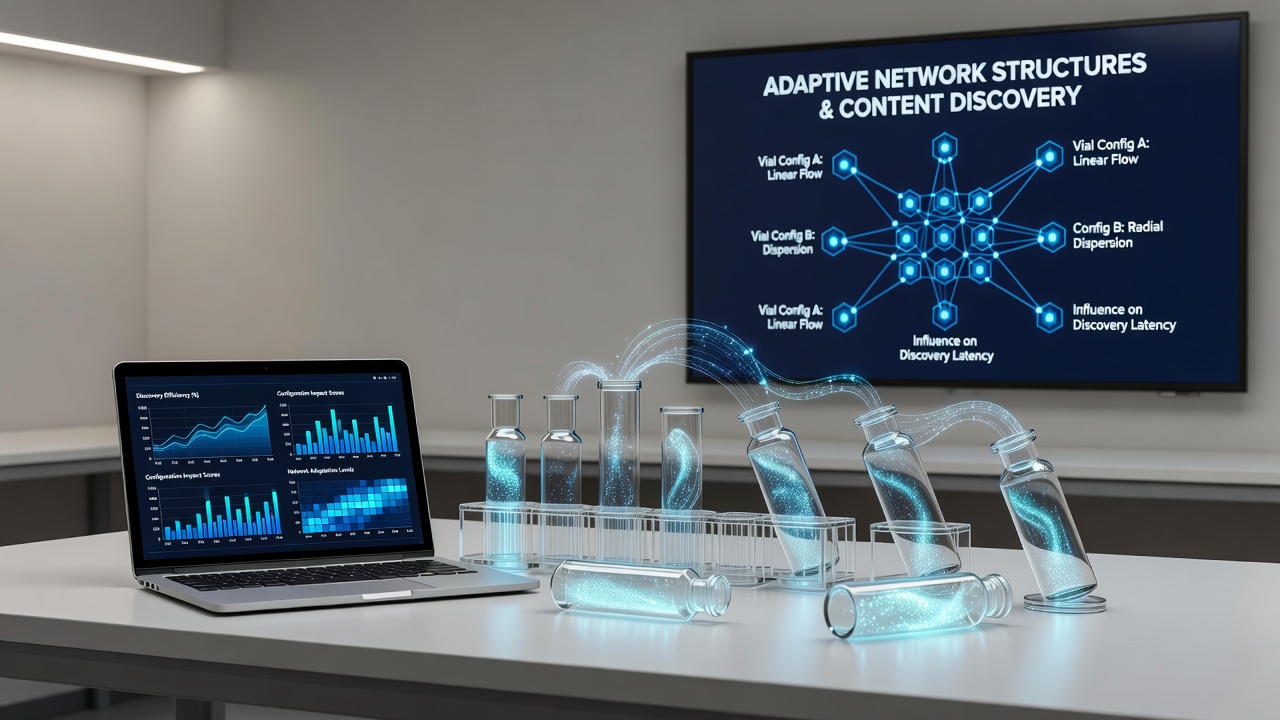
Adaptive structures continuously rebalance vial placements in response to usage patterns, and this rebalancing process interacts with discovery protocols through feedback loops that update routing tables. Researchers at institutions tracking large-scale deployments have documented cases where vial migration triggered temporary spikes in discovery failures until indexes propagated, yet the same systems later demonstrated improved resilience once the new configuration stabilized. The timing of these migrations matters because discovery agents that operate on stale maps generate redundant queries that consume bandwidth without yielding new results.
Observed Patterns in Operational Environments
Operational data collected across multiple regions show that vial configurations tuned for specific content types produce measurable differences in index freshness and retrieval accuracy. Networks serving scientific datasets, for instance, benefit from vials that emphasize version tracking and checksum validation, whereas media distribution networks prioritize vials that support rapid thumbnail or preview generation. A report issued by the European Telecommunications Standards Institute outlines how such specialized configurations integrate with existing discovery frameworks without requiring protocol overhauls.
Observers tracking systems in North America note that vial configurations incorporating machine-learning predictions for content popularity allow discovery processes to prefetch likely targets, and this approach reduces the number of failed queries during peak periods. The same datasets indicate that networks without predictive elements experience higher variance in response times when traffic patterns shift unexpectedly.
Integration with Broader Network Protocols
Vial configurations interact with standard protocols such as distributed hash tables and gossip-based dissemination methods, and the degree of alignment between these layers determines overall system efficiency. When vial boundaries map cleanly onto protocol-defined zones, discovery messages traverse fewer hops, and acknowledgment traffic decreases accordingly. The National Institute of Standards and Technology has published guidelines on aligning containerized data units with protocol requirements, and those documents provide reference architectures that operators have adapted to their own environments.
Changes in vial configuration also affect security posture because discovery processes must authenticate each vial they encounter, and mismatched authentication scopes can introduce delays or outright blocks. Research teams examining these interactions report that incremental configuration updates performed during low-traffic windows minimize service interruptions while still allowing the network to adapt to long-term demand growth.
Conclusion
Vial configurations shape content discovery outcomes through their effects on indexing speed, query routing, and resource reallocation, and evidence gathered from operational networks confirms that deliberate tuning of these elements produces consistent performance differences. Continued monitoring of configuration changes in live environments supplies the data needed to refine models that predict how future adjustments will influence discovery efficiency across evolving topologies.